Mule
The Eight Mountains: A NovelThe mule is a recurring working animal in the mountain life shared by the narrator and Bruno, carrying building supplies, provisions, and eventually the first cheese from Bruno’s farmstead down to the valley. Its appearances give material form to the labor of rebuilding Barma mountain house and to the repeated passage between the high pastures and Grana mountain village. The mule is not merely a means of transport: the burden it carries affects how people travel, and its familiarity with the path makes it part of the practical knowledge by which life in the mountains is sustained.
Building and Provisioning Barma
During the reconstruction, the narrator uses a mule to carry sand from the shore of Lake at the foot of Grenon. He fills its saddlebags at a small beach on the far side of the lake and makes repeated journeys back to Barma, where the sand is mixed with cement. Cement is used sparingly because it must be carried uphill in twenty-five-kilogram sacks; the work depends instead on carefully laid stones, with smaller stones and sand-and-cement mixture helping bind the walls. The mule therefore participates in the making of the house through an unglamorous but essential chain of transport: material gathered at the lake becomes part of the structure holding the walls together.
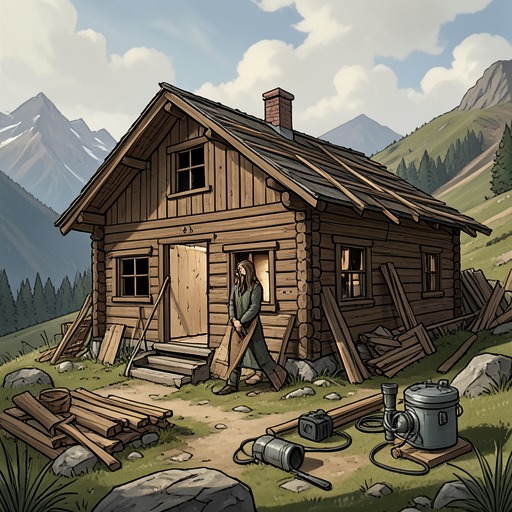
The mule also carries the equipment needed for the roof. In July, after the walls are complete, the narrator loads onto it eight steel brackets, expansion screws, a small generator, petrol, and his old climbing gear. The load supplies the means for a demanding task on the rock face: secured among four larch trees, the narrator drills thirty-two holes to fasten the brackets. Bruno has designed the brackets and calculated their spacing to withstand snow striking the rock in winter. The mule does not take part in the drilling, but its hauling makes the work possible, linking the routine movement of supplies to the roof’s engineered resistance to mountain weather.
The Familiar Route and Daily Life
As the rebuilding continues, the mule carries provisions on the narrator’s weekly journey down to the village. Once loaded with bread, vegetables, salami, cheese, and wine, it is allowed to find its own way along a path it now knows by heart. That confidence contrasts with the narrator’s continued dependence on the path as a chosen refuge: after a few hours among cars and shops, he is glad to return uphill. The animal’s practiced route makes the mountain settlement seem capable of supporting a life apart from the village, even as its supplies still depend on regular trips between them.
The mule’s journeys also belong to an older pattern of movement between Grana mountain village and the pasture. As a boy, Bruno repeatedly came up from the village in August and left the pasture to spend time with the narrator, despite being beaten by his uncle for bunking off. Years later, the narrator recalls that same road while accompanying Lara down with cheese. The mule’s transport work gives the path a changed purpose, but the route remains recognizable: a passage once associated with the boys’ meetings now carries produce from Bruno’s farmstead towards the valley.
The Cheese Descent
By the time the first batch of Bruno’s cheese is ready, he has acquired a different mule for the farmstead. The narrator distinguishes this animal from the gray male he used years earlier to transport cement: the new mule is female, smaller, and thick-coated, better suited to farm life. Bruno has made a wooden packsaddle for her, and on it he stacks twelve loaves of cheese, weighing sixty kilos in total. This is the first valuable load dispatched from the farmstead to the valley, turning the mule’s familiar role as carrier into part of Bruno’s attempt to make a livelihood from mountain farming.
The descent requires attention to the animal’s body and balance. The narrator walks ahead, with Lara behind him and the mule following; a dog that accompanies Lara brings up the rear. The mule initially advances unsteadily as she adjusts to the weight. Going downhill calls for more care than climbing back up, because the packsaddle shifts the load forward onto her front legs. On the steepest slopes, the narrator helps by holding firmly to a rope tied around her neck. The account emphasizes how the journey’s success depends on adapting human movement to the animal’s burden and footing, not simply on loading the cheese and setting off.
Work, Continuity, and Change
Bruno sends the mule down with Lara while he stays behind to clean the stable. His decision continues a division of labor already established on the building site: transportation is work he does not undertake himself, and he remains in the mountains while Lara carries goods between farmstead and valley. The mule thus supports the farm’s connection to the outside world without requiring Bruno to leave the place where he has chosen to stay. Its role makes that choice concrete: the farm’s produce can move down even as its keeper remains above.
The new mule is addressed by Bruno as Berio and is told that she knows the way. The name recalls the narrator’s boyhood: Bruno had used it for him, when he came up from Grana mountain village every day in August and Bruno left the pasture to join him. In the present, the narrator and Lara carry Bruno’s cheese along that same road. His reflection that much has changed while everything remains the same is grounded in the mule’s passage: the farmstead and river have changed, and the cargo is now cheese, but the route still joins the pasture to the valley. Across the animal’s appearances, transport links separate moments of the story—building, provisioning, and commerce—while showing how mountain life depends on repeated, physical journeys.